
Myanmar Spring Chronicle – December 14 Situation Overview
(MoeMaKa) December 15, 2025
The Military Commission’s Blind Spot
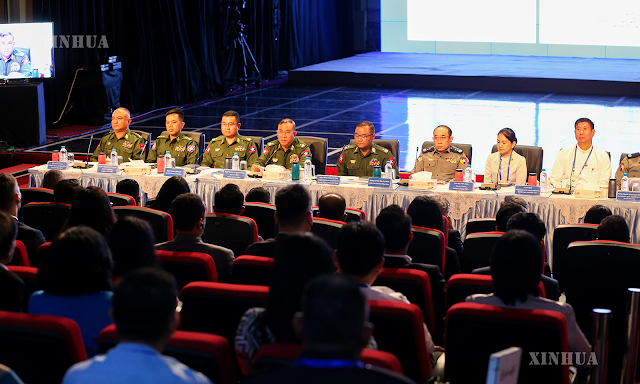
On the morning of December 14, the coup regime held a press conference at the Myanmar Radio building in Yangon to brief the media on its so-called efforts to eradicate online fraud.
The core message from the junta was repeated over and over: that it does not permit or tolerate online scam operations or gambling, and that it is “actively cooperating” with the international community to crack down on such crimes. They denied any involvement in online fraud schemes, gambling businesses, money-laundering, human trafficking, narcotics production and distribution, or the protection of armed criminal gangs.
Yet, at the same time, they effectively admitted that they had long known about these issues and had failed to act.
They stated that:
-
illegal income from scam centers is used to purchase illicit goods in border regions;
-
those goods are then smuggled across borders and sold, converting the criminal money into “legitimate” income;
-
equipment, food, and other supplies needed for scam centers are transported via untaxed, illegal border trade routes;
-
and the workforce needed for scam centers is obtained through human trafficking along those same illegal routes.
Taken together, these points are an indirect admission that, throughout the junta’s time in power, Myanmar’s trade and commercial flows—especially in the border economy—have been propped up by money from scam centers.
While the military pushes hard to hold elections as its escape route, it is simultaneously under pressure over transnational online fraud and human trafficking, and it continues to heavily abuse its air power. In Rakhine State and other ethnic areas where resistance forces are based, the junta has been escalating airstrikes on civilian neighborhoods, hospitals, and schools. In other words, it is continuing to commit war crimes.
The international community is condemning these crimes, and many voices argue that any election held under such conditions, according to the junta’s own design, cannot be recognized as legitimate.
Even so, analysts believe that the junta leadership will keep trying to move forward by exploiting the silence or passivity of certain neighboring states—China and India in particular, as well as some ASEAN countries that still stand back from clear condemnation.
Globally, we are in a moment when powerful states are asserting influence over entire regions:
-
the United States maintaining dominance in the Western sphere;
-
Israel’s brutal repression of Palestinians;
-
Russia’s coercive reach into Ukraine and other parts of Europe;
-
and China’s increasingly assertive behavior toward Taiwan and its neighbors.
Smaller and weaker countries are trapped in these geopolitical tides—and in that chaos, some military dictatorships see a window of opportunity to entrench their own rule and extend their grip on power.
For Myanmar’s generals, the calculation seems to be that with China’s backing as a shield against the Western bloc, and with neighboring countries preoccupied by their own political instability, international pressure will not truly bite.
But the junta’s biggest blind spot is the Spring Revolution forces—their movements and momentum.
The military today enjoys no genuine support from the population, and no public trust anywhere in the country. Apart from temporary ups and downs and short periods of weakness on the resistance side, most analyses suggest that the armed uprising is not on a trajectory of collapse or disappearance.
As long as the military continues attacking civilians, it will face fierce resistance and counterattacks from revolutionary forces. And if the military ever pauses its attacks, resistance forces are likely to push forward and attempt to remove the junta entirely.
Within the revolutionary camp, the main problems are the frictions, disputes, and internal conflicts between different organizations. These have not yet escalated into full fragmentation or collapse, largely because the people of Myanmar—who still broadly support and morally sustain the revolution—have helped hold the movement together up to now.