Myanmar Spring Chronicle – Scenes from December 23
(MoeMaKa) December 24, 2025
The impact of politically linked killings on the revolution
In recent days, one news story that many people have read concerns the killing of a CDM teacher and her husband, followed by related reports after Brigade 4 territory of the KNU issued a statement saying the perpetrators had been arrested.
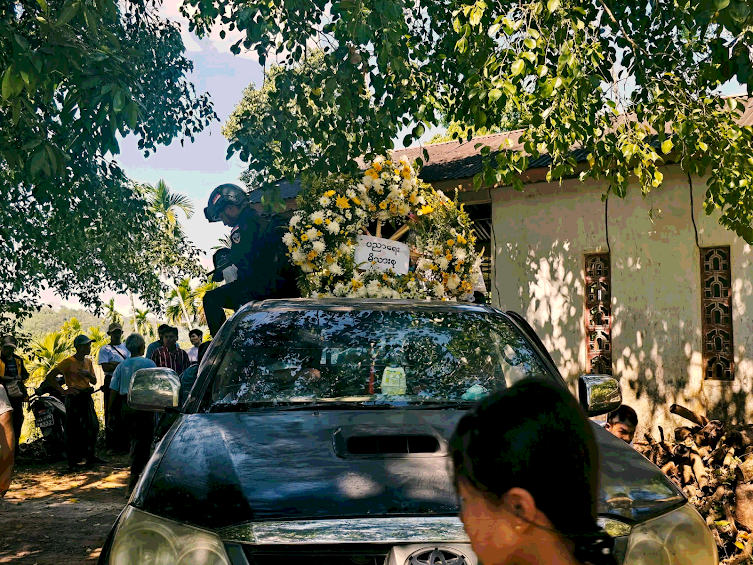
In Sal Khe Village, Palaw Township, Tanintharyi Region, CDM education staff member Daw Aye Thi Aung and her husband U Pyae Phyo Naing were killed in their home after midnight. Neighbors only learned of the murders the next morning. Reports said that although people heard cries for help in the middle of the night, it was dark and neighbors were afraid to intervene.
The area where the incident occurred is under the control of KNU Brigade 4. After conducting inquiries, the KNU announced a few days later that it had arrested those responsible.
According to the Brigade 4 statement, the perpetrators were individuals who had escaped from a detention cell of KNDO Battalion 7, a unit under Brigade 4, and they allegedly confessed to killing the CDM teacher and her husband. The statement said the killers were deserters from the junta side who had been held by KNDO Battalion 7 and then escaped, after which they committed the murders.
However, some local residents reportedly believe the statement was not based on a thorough investigation of the scene. There are suspicions that certain facts may have been concealed, or that the case was hastily “closed” by blaming scapegoats because a full investigation could not be carried out.
This incident is only one of many similar events occurring across the country during the armed revolutionary period. A comparable case took place in Kani Township, Sagaing Region, toward the end of 2024, when education board member U Win Htay and his family were killed. He, his wife, and their infant were reportedly murdered at home by unknown assailants in November 2024. These are two cases in which education-sector personnel—specifically CDM education staff—were killed along with family members. In this transitional period—when there is no stable, established administration—there have also been many cases of ordinary civilians (not CDM staff, and not administrative, education, or health workers) being killed.
Incidents involving armed resistance members against one another, as well as killings of civilians committed by armed group members, have been occurring in regions such as Sagaing, Magway, Mandalay, northern Shan, Tanintharyi, southern Shan, Mon, and Karen areas.
Some incidents can be described as non-political criminal acts. But in other cases, killings have occurred during this interim period based on political positions—whether due to suspicion or some allegation.
When armed organizations abuse power and carry out extrajudicial arrests and killings, or when conditions allow crimes such as robbery, murder, and rape—and even the killing of infants together with their families—these acts can steadily damage the image of the revolution.
The public has come to support the Spring Revolution’s armed resistance because they no longer accept the coup military: a force seen as unlawfully seizing power, torturing and killing civilians, arresting people arbitrarily, handing down long prison sentences and even death penalties, and in some cases arresting someone one day and informing the family the next day to collect the body.
In broad terms, people tend to see the coup military as “black” and the resistance forces as “white,” and they hope the revolutionary forces can deliver justice for the public.
People have also hoped that the revolutionary forces would be accountable armed groups—capable of building fair governance and functioning justice mechanisms.
Even when mistakes happen, the expectation is that these groups will admit wrongdoing, correct errors, take responsibility, provide restitution, and put safeguards in place so similar abuses do not happen again—through armed organizations, administrative bodies, and judicial bodies that are truly accountable.
To prevent these hopes and trust from being destroyed or lost, leaders and leading organizations of the revolution must act with full accountability and responsibility. If, because revolutionaries have already made sacrifices—or because of “reasons to be considerate” such as reluctance to criticize another group’s weaknesses—the justice the public expects is not delivered, then the Spring Revolution and the struggle for ethnic liberation will take longer to succeed.
If all armed groups come to be seen as the same—once armed, behaving like rulers over the people, or acting like benefactors demanding gratitude—then it will become difficult to define them as revolutionary organizations. Likewise, if the mindset takes hold that “because we are risking our lives fighting the dictatorship, the public should not demand justice, good governance, accountability, or responsibility during this period,” it will also be hard to regard them as genuine revolutionary forces.
In such circumstances, public trust in the revolution can collapse, and the country could end up in a situation where only the rulers have changed while the goals and purpose have not—leading to a loss of hope. That is what we must be mindful of.