
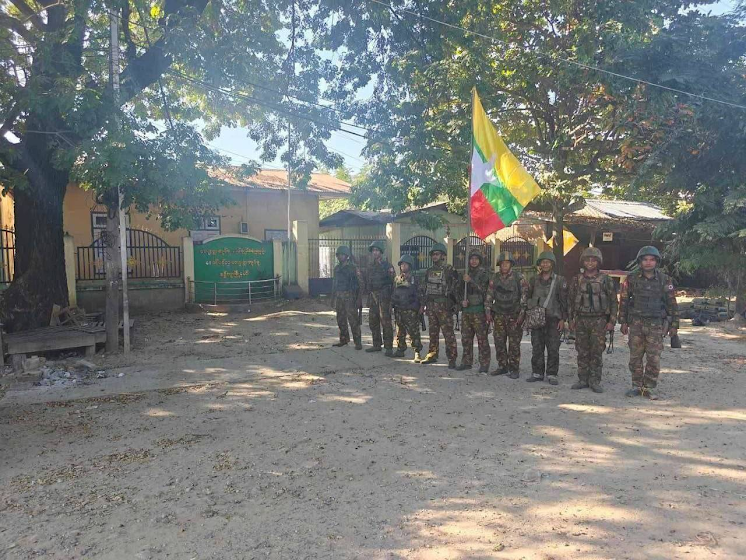
Myanmar Spring Chronicle – December 19 Scene
(MoeMaKa) December 20, 2025
The coup regime’s military attacks and control of Singu town and Letpan Hla village
News reports say that the coup regime’s forces, which had been mounting an offensive for months, recaptured Singu town—a town in Mandalay Region that MDY PDF forces had seized and controlled for more than a year in parts of Mandalay Region and adjacent areas of northern Shan State under an operation they named the “Shan–Mandalay Operation.” The reports say the regime retook Singu on December 18.
In addition to Singu, which lies on the eastern bank of the Ayeyarwady River, reports also say the military retook Letpan Hla village, a major strategic village east of the town on the Mattara–Thabeikkyin–Mogok road.
Letpan Hla is located on the Mandalay–Mogok road and is regarded as a key and militarily important point. The coup regime has frequently carried out airstrikes against it. There are many gold mines in Thabeikkyin and Singu townships, and MDY PDF is also known to collect taxes from these mines. Based on the eastern side of the Ayeyarwady in Upper Myanmar, the MDY PDF armed force—unlike many revolutionary armed groups in Sagaing Region on the river’s western side—has been organized as a single, consolidated armed organization. Because it receives substantial revenues from taxes collected in gold-mining areas such as Thabeikkyin and Singu, it is also financially strong. It has close ties with the Ta’ang National Liberation Army (TNLA) and is understood to have received military training, ammunition, and other assistance from the TNLA, which helped MDY PDF build up its strength.
After launching operations on October 27, 2023, MDY PDF joined territorial seizure operations in 2024 alongside the three Northern Brotherhood ethnic armed organizations. It took part in capturing towns such as Nawnghkio, Kyaukme, and Mogok, and also managed to seize towns in Mandalay Region including Singu, Thabeikkyin, and Mattara.
However, from early 2025, several developments appear to have enabled the coup regime to launch stronger offensives toward Mandalay Region and Sagaing Region: it was able to reach a ceasefire with the MNDAA, revive conscription to replenish manpower, employ drone and other modern technologies in the civil war, and—with reduced territory and fewer active fronts in the northeast—no longer needed to open as many battlefronts. That is the conclusion that can be drawn.
The ceasefire agreement with the TNLA at the end of last October gave the military some breathing space regarding the northern Shan and Mandalay fronts. Some had predicted that, even with a TNLA ceasefire, the coup regime would still be unable to deploy large forces. But in reality, regaining Mogok and Momauk/“Momeik” and the fact that fighting largely ceased across areas such as Kyaukme and Nawnghkio has indeed allowed it to focus more on Mandalay and Sagaing.
At present, the coup regime has not yet reached a position where it can control in one continuous belt Mattara, Singu, Thabeikkyin, Mogok, and Momeik. Even so, if it can control the towns and secure control of the Mandalay–Mogok highway, it could create obstacles for revolutionary forces’ movement and logistics routes—routes that pass through northern Shan, southern Shan, and Sagaing Region, as well as Yaw, Saw, and the Kalay plain.
It is certain the coup regime already understands these points. It is clear that its strategic objective is to cut off revolutionary supply lines and to prioritize offensive operations against resource-rich areas that generate substantial tax revenues. This also means there is a growing risk that the current situation—where revolutionary forces can move relatively freely across much of Upper Myanmar—could be disrupted.