Myanmar Spring Chronicle – Scenes from December 24
(MoeMaKa) December 25, 2025
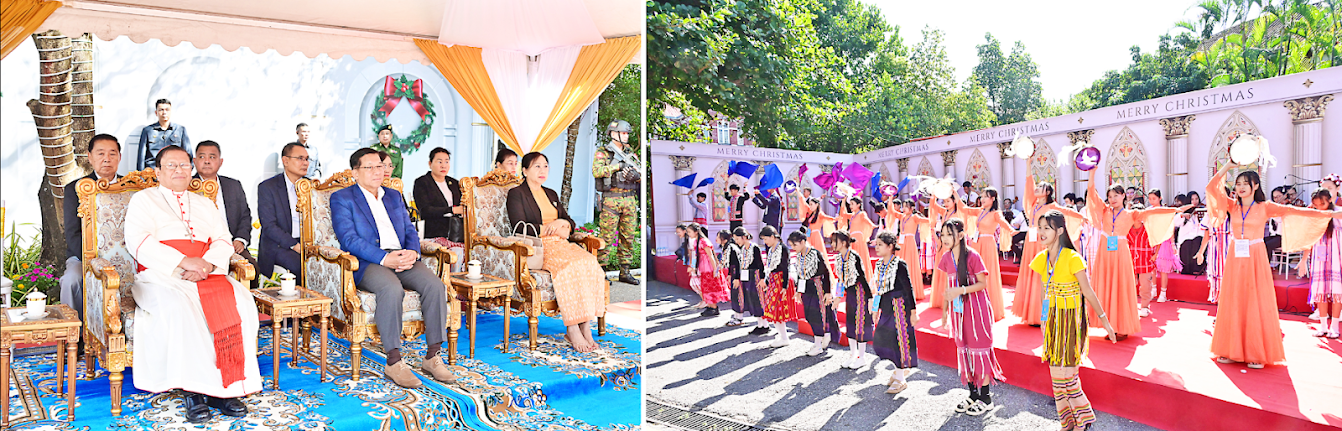
The coup leader attends a Christmas event held in Yangon
News reports said the coup leader attended the annual Christmas thanksgiving and praise ceremony held at St. Mary’s Church on Bogyoke Aung Kyaw Road, in Botahtaung Township, Yangon. The event at St. Mary’s Catholic Church was reportedly organized by the Myanmar Council of Churches (an umbrella body of Christian denominations), and included a Christmas thanksgiving/praise program and a fellowship meal.
At the ceremony, the coup leader delivered greetings beginning with a wish along the lines of: May all citizens and all people around the world live in love and peace under the shelter of religion’s compassion. Yet even as he spoke of goodwill and prayer, in parts of Myanmar the military’s airstrikes were continuing to kill and injure people—not only armed groups but also displaced civilians and residents struck by unexpected aerial attacks while at home. This starkly illustrates how far words and reality diverge.
In many areas where large numbers of Christians live—Kachin, Chin, Karenni (Kayah), Karen, Tanintharyi, and Sagaing—the military under Min Aung Hlaing has been carrying out air attacks that kill civilians, heavy artillery shelling on the ground, troop raids followed by the burning and destruction of homes, and arrests, torture, and killings based on suspicion that civilians support the PDF or ethnic armed organizations.
Over the past four to five years, many churches have also been damaged or destroyed by air and ground attacks across the country. The essay argues that Min Aung Hlaing is not unaware of this; rather, despite knowing these realities, he appears at Christian events and offers blessings as a form of deception aimed at polishing his public image.
The piece further argues that, for political and military advantage and to consolidate power, the coup regime would not hesitate to suppress, crush, arrest, torture, or kill people of any faith—Christian, Buddhist, Hindu, Muslim, or others.
Because it is so evident that claims of “religious freedom” and holiday greetings are being used to mask abuses committed against Christian civilians, a difficult question arises among Christians: why do religious leaders not use such encounters to tell the coup leader to stop atrocities and prevent further abuses against civilians? The author says this question can cause deep repercussions within Christian communities.
As an example, the article notes that St. Michael’s Church in Monhla Village, Khin-U Township, Sagaing Region—the hometown village of Cardinal Charles Bo, a prominent leader in Myanmar’s Catholic community—was reportedly hit and damaged by a military air attack just last month.
In previous years as well, many Catholic villages in and around Monhla, Khin-U, and Tant Se townships reportedly faced military raids, arson attacks on homes, interrogation and abuse of civilians found in villages, and in some cases killings. Given such incidents—civilians killed, churches damaged or burned, and attacks from air and ground—the author says not only Christians but also people of other faiths are likely to question whether religious leaders have truly remained silent when meeting the coup leader.
The argument is that even if church leaders cannot speak on all national issues, they should at least speak up about killings of civilians and destruction of homes and religious buildings in Christian communities.
The author adds that this public desire for religious leaders to admonish the coup leader when the opportunity arises is not aimed only at Christian leaders; it also applies to senior Buddhist monks. When the coup leader visits religious leaders for political outreach or makes donations, Buddhist monastic leaders too, the author says, should urge him to stop arrests, torture, and killings of civilians, stop burning villages and homes, and stop airstrikes. Even if the coup leader is unlikely to accept and change easily, such admonitions would still underscore that he bears responsibility for these acts and for war crimes.