
Myanmar Spring Chronicle – December 7 Overview
(MoeMaKa) December 8, 2025
Thai Foreign Minister Makes One-Day Trip to Naypyitaw
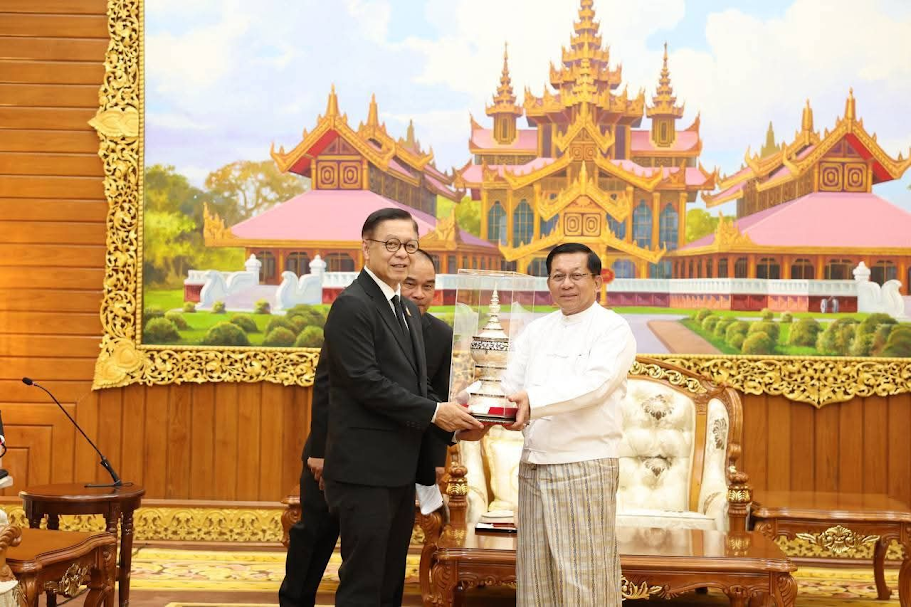
Only a few weeks after openly stating that Myanmar’s upcoming election would not be acceptable and would not solve the country’s political and armed conflict, Thailand’s Foreign Minister Sihasak Phongphakdi led a delegation—including senior Thai military officials—on a day trip to Naypyitaw on December 7 to meet with Myanmar’s military junta.
According to reports, the Thai Foreign Minister and accompanying Thai military officers held separate meetings with junta leader Min Aung Hlaing, the junta-appointed Prime Minister, and the junta’s Foreign Minister.
In the statement released by the junta’s side, the visit was described in a subtly elevated tone as a “courtesy call on the Acting President,” revealing how the military regime attempted to frame the meeting politically.
This sudden visit appears to be linked to recent escalations along the Thai–Myanmar Mae Sot–Myawaddy border, including artillery shells landing on the Thai side during clashes between the KNLA and the junta, and ongoing crackdowns on online scam syndicates operating along the border.
Several artillery rounds fired during cross-border fighting recently landed in a Thai village near Mae Sot, injuring Thai civilians. This is likely one of the main reasons behind the Thai Foreign Minister’s quick flight to Naypyitaw.
What has surprised many Myanmar observers is the drastic shift in the Thai minister’s tone:
Just weeks ago, he publicly stated that Myanmar’s coming election was unacceptable and would not resolve the country’s political or armed crisis.
Yet during this latest visit, according to Thai sources, he told junta leaders that the election could be seen as “part of a broader peace process and a significant political transition.”
This reversal contradicts his earlier remarks and has left many Myanmar people stunned.
The inconsistency raises questions:
Was the earlier statement merely a personal opinion?
And is the latest position a reflection of underlying preferences within the Thai government and Thai military leadership?
Thailand’s military, which has historically had a close relationship with Myanmar’s armed forces, is believed to exert stronger influence over Myanmar policy than Thailand’s civilian politicians—especially on border and security matters.
Despite artillery shells landing on Thai soil and injuring Thai civilians, the Thai military has not issued any strong warning or condemnation of the Myanmar junta—an approach very different from Thailand’s stern handling of its own border disputes with Cambodia in past years.
Meanwhile, the junta’s demolition of large scam center complexes in Myawaddy—many built and operated by Chinese networks under the protection of BGF/DKBA—has caused debris and disruption even on the Thai side, yet the Thai military’s response has remained restrained.
Urgent Issues for Thailand–Myanmar Relations
At the moment, Thailand faces immediate challenges that require rapid coordination with Myanmar:
-
Preventing further artillery shells from landing on Thai territory
-
Providing humanitarian assistance and safe shelters to Myanmar civilians fleeing across the border
-
Addressing emergency food and shelter needs
-
Stopping illicit cross-border arms trafficking
-
Stabilizing border trade routes that are economically vital to both countries
Political Timing in Thailand
Thailand’s current government has only a few months left in its term, with general elections expected early next year. The administration has been in office for just four months, so Myanmar-related policy positions may reflect individual viewpoints rather than long-term national strategy. Thai military leaders—who do not face elections—may also be shaping Myanmar policy independently of elected politicians.
Given this, it is likely that the Thai military’s position carries greater weight in dealings with Myanmar than the views of Thailand’s civilian politicians.
Impact on the Myanmar Revolution
The Thai Foreign Minister’s recent comments about Myanmar’s election—comments that appear to legitimize the junta’s planned sham vote—have caused disappointment among Myanmar pro-democracy and revolutionary groups.
For many fighting the dictatorship, the shift feels like a diplomatic setback and a reminder that geopolitical interests often overshadow the suffering and struggles of the Myanmar people.