
Myanmar Spring Chronicle – View of December 1
(MoeMaKa) December 2, 2025
NUG’s administration and justice system now under questioning
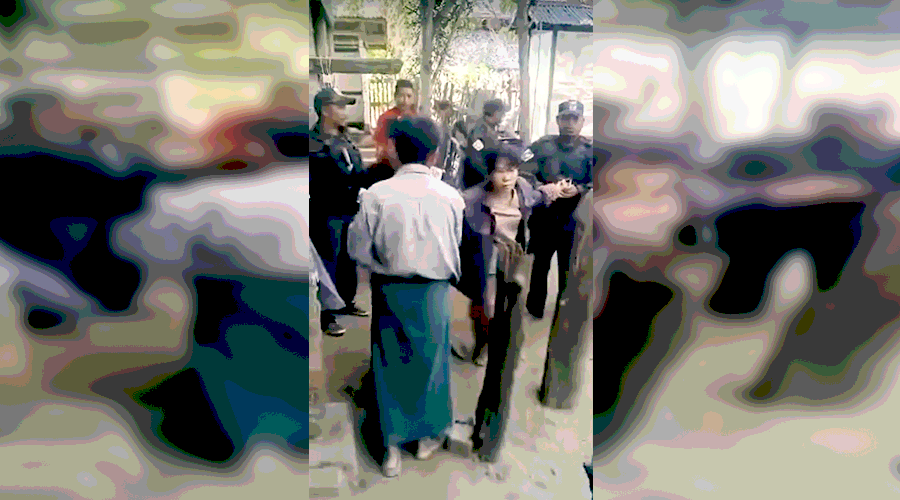
After a video spread on social media showing the arrest of CDM doctor Dr. Khin Thu Thu Lwin by the Min Kin Township People’s Security (police) force under the NUG on November 30, there has been widespread criticism of how the Min Kin People’s Security members operate under the National Unity Government (NUG).
People are criticizing:
-
The rough and degrading way a woman was arrested,
-
Dragging and manhandling her,
-
Pulling her by the wrists and forcing her along,
-
Armed People’s Security (PaLaFa) members storming in and hauling her off by force,
-
And doing all this without any female officers present.
Some have commented in defense of the arrest, saying things like:
“She had to be brought in this way,” claiming that:
-
She refused to return a rented weapon,
-
She failed to properly clear up financial accounts,
-
She threatened to throw hot water on the arresting team,
-
And even attempted to explode a gas cylinder on the ground–
and therefore, they argue, this kind of forceful arrest was justified.
Regarding the background that supposedly led to this arrest:
According to the NUG side, she:
-
Resigned from her post as township medical superintendent in Min Kin and joined the CDM after the coup,
-
Then served on the resistance side providing medical care and as head of the Min Kin People’s Security (PaLaFa) until 2024,
-
But after stepping down, she did not return an AK-47 rifle that had been issued to her on a rental basis,
-
And she did not formally hand over around 330 million kyat in tax and revenue funds she handled while serving as PaLaFa chair, according to proper procedure.
Because of this, the NUG says, an arrest order was issued. Some other reports, however, note that she had recently taken the lead in local protests against gold-mining operations in Min Kin Township, and suggest that this may also have been a factor in her arrest.
It is unclear:
-
Whether any legal action was taken during the more than one year since she stepped down as PaLaFa chair,
-
Or whether the arrest only came now because she led local administration bodies in protests against gold-mining.
What is clear, however, is that many people view the way she was arrested — as a woman doctor still providing healthcare in the area — as inconsistent with the behavior of a “good government” or a sound administration.
Critics emphasize:
-
She is a doctor who left her position as township medical superintendent in support of the Spring Revolution,
-
She stayed in the area and continued serving local health needs,
-
She is a woman,
-
Yet she was arrested so roughly that it could be considered physical violation and degradation, to the point of disfiguring her appearance.
People say this makes NUG forces look indistinguishable from the junta and military dictatorship.
Some are also shocked to see others publicly supporting the NUG’s explanation that because she did not return a weapon and did not properly hand over the finances, such a method of arrest was “appropriate.”
At this point, it is worth comparing with a 2021 incident:
Around March 2021 in Nay Pyi Taw, a video circulated of a female doctor being summoned and arrested by plainclothes special police and regular police. In that incident:
-
The special police team in civilian clothes included female officers,
-
There was no violent dragging or manhandling;
-
They spoke to her, and she walked with them while others followed behind.
When the doctor said she needed to pick up some clothes and essentials, her family and neighborhood residents started filming and confronting the officers. In the end, at the house entrance, the police backed down in the face of the community’s outcry and withdrew. The doctor was not arrested and was able to escape.
If we study that case, we see that:
-
Those who ordered the arrest had clearly given detailed instructions about how it should be carried out,
-
And those tasked with the arrest did not exceed those instructions in their methods.
For any government, it is essential to:
-
Set clear procedures and protocols,
-
And strictly enforce them for law-enforcement bodies like the police, whose role is to uphold the rule of law.
Now, for NUG’s People’s Security forces:
-
It is crucial to have clearly defined procedures for arrests and enforcement,
-
And in dealing with civilians, if armed units act like the junta’s forces, their administration will inevitably be judged on the same level as authoritarian regimes.
Beyond administrative procedures and the conduct of People’s Security forces in law enforcement, another critical issue is justice.
The NUG has a Ministry of Justice, and in PDF-controlled areas in Sagaing, Mandalay, Magway and Bago Regions, this ministry is supposed to oversee judicial affairs.
However, the ministry seems to focus mainly on:
-
Highly publicized cases,
-
Cases that have already gone viral on social media,
and even in some of these high-profile cases, many people say fair and effective judgments have not been delivered.
One memorable example is from late 2021 in Yinmarbin Township:
-
The killings committed by Bo Than Mani and his group were never properly prosecuted or judged,
-
This failure in justice has led the public to lose confidence in the judicial system.
Similarly, other incidents involving:
-
Killings and sexual assaults committed by members of armed groups,
have not been addressed with proper, effective justice, further weakening reliance on NUG’s judicial mechanisms.
It is extremely important that even under current wartime conditions, large-scale human rights violations and killings carried out by armed groups be prosecuted now, not postponed.
Claims like “we will accept responsibility and punishment after the revolution is over” are seen as attempts to evade or delay accountability.
As the revolution drags on, people expect:
-
The rule of law and the justice system to improve, not deteriorate.
The public accepted for a time that:
-
“This is a revolutionary period; top priority is overthrowing the military dictatorship; other issues can come later.”
But increasingly, they now see this as an excuse used by some to sidestep responsibility and accountability, and they no longer accept it so easily.