
Myanmar Spring Chronicle – December 4 Snapshot
(MoeMaKa) December 5, 2025
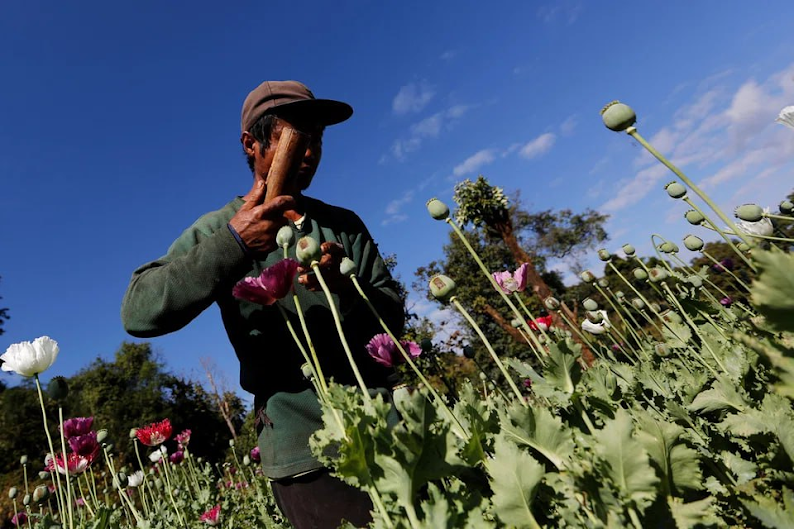
Myanmar Still the World’s Top Opium Producer
War and political crisis continue to ravage Myanmar, and at the same time the country remains the world’s largest cultivator of opium poppy for illegal narcotics production, according to the latest annual report from the UN Office on Drugs and Crime (UNODC).
For many decades, Afghanistan was the country with the world’s largest area under opium poppy cultivation and the biggest producer. But in recent years, as the Taliban authorities in Afghanistan have moved to suppress opium cultivation, Myanmar has overtaken Afghanistan and now holds the top position for both cultivation and production.
According to the 2025 report, Myanmar currently has more than 50,000 hectares under opium poppy cultivation, a 17% increase compared to last year. The report notes that a viss of raw opium now fetches over 300 US dollars, a price that strongly attracts growers. With the ongoing civil war disrupting transport routes and making it uncertain whether other crops can be marketed, many farmers see opium as a more “viable” option because it is easier to move and sell.
The areas where opium is cultivated are not so much active frontline war zones as they are territories controlled by various armed actors: groups that have ceasefires with the junta, border guard forces, and organizations still fighting the military. These include different armed groups’ territories in eastern, northern, and southern Shan State, Karenni, Kachin State, northern Sagaing Region near the Indian border, and Chin State along the Indian frontier.
Parts of eastern and southern Shan State, especially the northern parts, have had continuous opium cultivation for decades. These are the same regions that became infamous in the 1960s, 70s, and 80s, when Shan armed conflicts, People’s War forces, and various “liberation armies” deeply involved in the opium trade made world headlines.
Although opium poppy cultivation is illegal under both international and Myanmar law, farmers who grow opium need armed groups to provide “protection” in exchange for taxation. Those same armed groups also protect traders who purchase the opium and transport it across borders.
While it is true that farmers can earn more per unit from opium than from other crops, that doesn’t mean they are able to accumulate substantial savings. With the collapse of the legal economy, border trade routes closed, and transport costs soaring, it has become extremely difficult to profit from ordinary crops. So in today’s civil war conditions, many farmers turn to opium as the only way to survive.
In the past, before the current phase of armed conflict, farmers in some regions could plant corn and sell it across the border to Thailand and China. Those conditions no longer exist. For such crops, timing is crucial – they must be transported to market quickly. In a situation where roads are blocked, border gates are closed, and delays are frequent, farmers face serious risks of loss.
By contrast, raw and processed opium can be stored relatively easily, in a compact form, and sold later when conditions are favorable. This flexibility is one of the reasons opium cultivation looks attractive as a livelihood strategy.
In more peaceful periods, there were development programs supported by the international community and by the government to promote alternative crops and livelihoods for local farmers. But with war flaring up again and armed groups needing large sums of money to finance military operations, taxing opium cultivation and the drug trade has once again become a key source of revenue for many of these actors.
When people hear “opium cultivation,” they tend to think only of Shan State. But in recent years, it is no longer confined to Shan alone. Mountainous areas with favorable climate—such as Chin State, parts of Sagaing Region, and Kachin State—have also seen increasing opium cultivation.
As the rule of law weakens, opium-growing areas expand, and cultivation has spread into regions where poppy was not traditionally grown. In Chin State’s northernmost townships such as Cikha and Tonzang, opium cultivation has a history of only about a decade. Now, UNODC reporting shows that in northern Sagaing Region along the Indian border, there are already hundreds of hectares under opium poppy.
Alongside opium cultivation, narcotics production facilities are no longer limited to Shan State’s “People’s War” zones or armed-group territories. Reports indicate that methamphetamine and other synthetic drug labs are spreading to other parts of the country as well.
In a recent article from The Irrawaddy’s Burmese edition, for example, journalists investigated a methamphetamine factory operating in an area of Myawaddy Township controlled by the DKBA.
Most methamphetamine pills are still manufactured in Shan State and then trafficked across Myanmar’s territory to Bangladesh and India in the west, and through Thailand in the east, before being shipped onward into the global market.
For decades now, Myanmar’s name has been associated internationally with heroin and methamphetamine exports. The infamous “Golden Triangle” and its opium and drug trade have been known to the world since many decades ago, and even today Myanmar is still widely recognized as a key producer and supplier of opium and synthetic drugs.