
Myanmar Spring Chronicle — December 18 Scene
(MoeMaKa) 19 December 2025
Junta steps up air and ground strikes in Sagaing and Mandalay regions
The junta’s intensified campaign follows the late-October ceasefire agreement with the TNLA, which effectively reduced the need for large-scale attention on the northern Shan front. Since last November, however, the military has increasingly launched both air and ground assaults against locally organized LPDFs and NUG-aligned PDF units across northern Myanmar — especially in Mandalay and Sagaing regions.
At the end of November, after the TNLA yielded back the towns of Moekok and Moemake, fighting continued around Moekok between local People’s Defense Forces and other anti-junta units; nevertheless, the situation in northern Shan no longer shows the kind of major concentrated battles seen previously.
In late October, prior to the TNLA agreement, the junta carried out airstrikes on towns including Kyaukme, Naungcho, Thibaw, Mantong, Namsan and Nammahtu. Today, the junta is mounting ground offensives and daily airstrikes in areas connected to Sinhtu and in Sagaing — including Khin Oo, Yay Oo, Dpeyin and Yinmapin — producing mass displacement: whole villages are moving, fleeing from frontline to frontline.
From the end of 2023 through early 2025 the junta lost control of many territories in northern Shan, Kachin, Chin states and Mandalay Region. During that period, air and ground operations in Sagaing’s villages decreased noticeably; the junta maintained control mainly over key towns — Shwebo, Wetlet, Chaung Oo, Ayadaw, Monywa, Yinmapin, Salin, Kani, Yay Oo, Khin Oo and Taze — while many inter-town roads and villages fell under PDF control. The junta’s presence became largely confined to administrative centers.
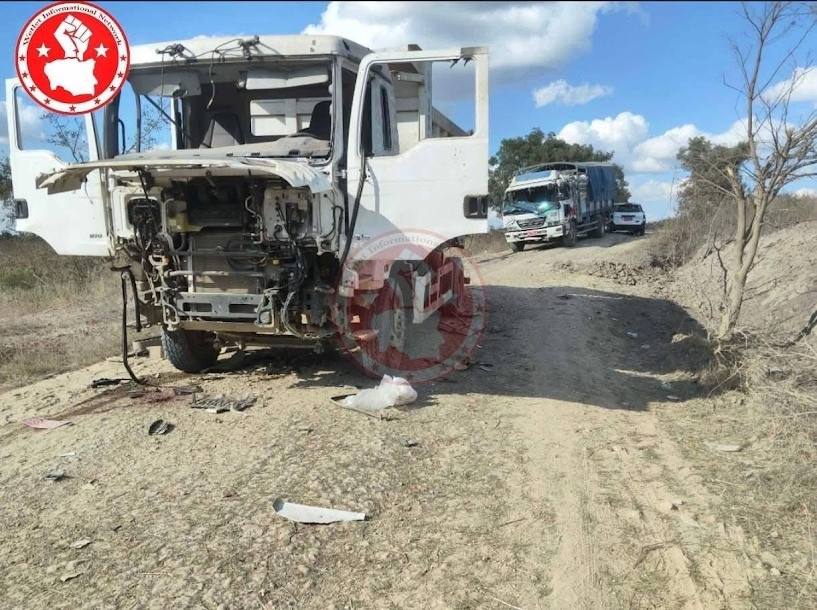
Recent events show a renewed pattern of strikes. For example, attacks by air on a convoy along the Shwebo–Myitkyina road in Khin Oo Township resulted in one death and six wounded, according to reports. Jet fighters and gyrocopters have been used. Since 8 December the junta has blocked the Shwebo–Myitkyina highway and used air power to hit the long lines of waiting vehicles — often targeting fuel-truck escorts and fuel-laden caravans.
One attack on 17 December on a passenger convoy on the Shwebo–Myitkyina road in Wetlet Township reportedly killed six civilian passengers. The junta frequently targets fuel transports sold within Kachin and Sagaing, which are moved along the Shwebo–Myitkyina route and onward to Kachin State — a major supply line for both civilian markets and for PDFs and mining operations.
It is not always possible to tell whether seized fuel is destined for civilians, for PDF units, or for small-scale extractive activities (gold or gem mining), so the junta tends to treat fuel logistics as a generic strategic target and strikes broadly without discrimination.
While these strikes continue in Sagaing townships such as Dpeyin, Wetlet and Khin Oo, the junta is simultaneously attempting to retake areas along the Mandalay–Moekok corridor that are under MDY-PDF control. After taking Moekok back into its hands, TNLA-aligned units have been active there; the junta has launched offensives to seize towns and surrounding stretches of the Mandalay road, including operations aimed at occupying Sinhtu.
For months the junta has attempted to retake roads, riverine districts and villages — parts of the Moekok–Mandalay road and riverbank communities that the MDY PDFs had previously held. As a result, some segments of the Moekok–Mandalay roadway and several villages have effectively slipped out of junta control.
Why is the junta attacking strategic axes such as the Shwebo–Myitkyina route and the Moekok–Mandalay road? The intention appears clear: to control supply and logistics routes. Controlling these arteries — the Shwebo–Myitkyina strategic line and the Moekok–Mandalay route — disrupts supplies of fuel, taxes, and resources that sustain PDF operations. Because MDY PDFs have been able to operate strongly in those regions, and because those roads are critical for moving fuel from Yangon–Mandalay via the Shwebo–Myitkyina corridor, the junta is deliberately seeking to sever and dominate these lifelines.
In short, the junta’s recent air and ground campaign looks like a deliberate operational plan to cut off material support and transport links that benefit PDF forces and local economies — a strategic bid to deny logistics, revenue and supplies to the resistance by taking control of, or disrupting, the key transport corridors.