
Myanmar Spring Chronicle – December 16 Scene
(MoeMaKa) 17 December 2025
Hopes for the Spring Revolution Alliance – and Lessons from History
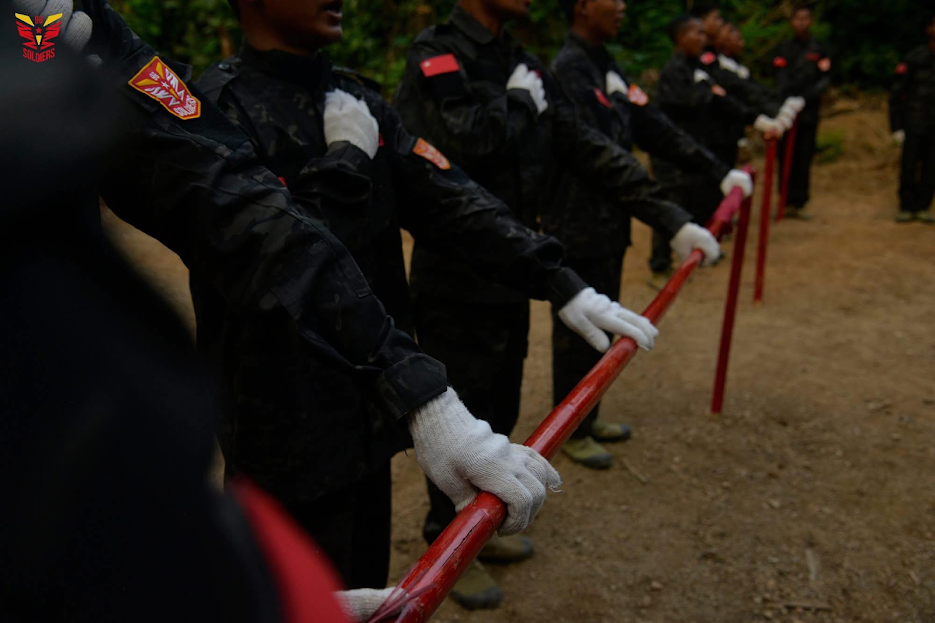
On 15 December, a statement was released announcing the formation of the “Spring Revolution Alliance” (SRA), composed of 19 armed resistance groups.
Among the groups now inside this alliance are:
-
KNDF from Karenni (Kayah) State,
-
BPLA, which has conducted joint operations in central Myanmar, the West, and parts of northern Shan,
-
Chin Brothers, active in southern and northern Chin State,
-
96 Soldiers from Sagaing Region,
-
Danu People’s Liberation Army,
-
GZ Generation Army (GZA),
and others.
One notable point is that this alliance does not include any of the long-established ethnic armed organizations that predate the Spring Revolution. Instead, what stands out is that it is made up of armed forces formed during the Spring Revolution period itself.
Another striking feature is that none of the units under the National Unity Government’s Ministry of Defense (NUG MOD) are part of this alliance.
We cannot say for sure whether this is because, from the NUG’s perspective, including themselves in such an alliance might blur lines of hierarchy and protocol—given that they see themselves as the government for the whole country—or whether the NUG simply intends to conduct its own military activities separately. That part is unclear.
Some supporters of the NUG have noticed this structure and are openly analyzing and commenting on it on social media.
One line of criticism starts from the question: Why aren’t they under the NUG MOD?
From that viewpoint, the thinking is:
“By tradition and protocol, the National Unity Government is the government of the whole country, so joint efforts should ideally be conducted under the NUG’s umbrella.”
Given that this new alliance brings together 19 groups that are geographically spread out, another question arises:
How will they actually conduct joint operations in military terms?
In areas where their territories are contiguous, there will be opportunities for joint operations. But in places that are geographically distant—like Myanmar’s far east and far west—it will obviously be difficult for member groups to be directly involved in each other’s operations.
Within the 19 groups, some are ethnic armed organizations, while others are Bamar-based armed forces.
For example, KNDF, Chin Brothers, the Danu People’s Liberation Army, and the Mon State Revolutionary Force can be broadly categorized as ethnic armed organizations;
while BPLA, GZA, 96 Soldiers, Magway People’s Defense Force, and “Burma Army” (the resistance formation) can be categorized as Bamar armed resistance groups.
Forming this alliance as a joint force will, without doubt, put pressure on the coup regime’s military.
In terms of military activity, weapons, ammunition, and expertise, the potential for mutual support among these forces will benefit the revolutionaries—and at the same time increase pressure on the junta’s army.
On the other hand, historical experience shows that after alliances are formed, differences in attitude and misunderstandings often emerge over time, and groups sometimes suspend their membership or withdraw altogether.
Because this has happened in the past, it is important to take those historical lessons seriously.
For an alliance to endure over the long term and to achieve concrete results, there must be shared political objectives and shared military objectives.
Simply sharing a hatred of Min Aung Hlaing’s military dictatorship is not enough to sustain long-term cooperation.
There must also be alignment in visions about the future state and system they want to build, and in the values they prioritize.
Additionally, regionalism, ethnic chauvinism, and prioritizing only one’s own group’s interests too heavily will harm the future of any alliance.
In Myanmar’s not-so-distant civil war history, there have been examples of ethnic armed organizations forming alliances.
Before the 1988 uprising, there was the National Democratic Front (NDF), and afterward there were other umbrella alliances that included ethnic armed groups and the Communist Party of Burma with its allied forces.
How those alliances were formed, how they initially managed to function, and what caused them to weaken over time—these are all historical lessons we should reflect on.
Of course, the current political and military context is different from the period starting after independence in 1948, when the civil war first broke out.
Still, as the saying goes, history tends to repeat itself. When similar root causes are present, similar consequences tend to appear. It is therefore crucial to pay close attention and learn from these historical patterns.
Only if we can properly absorb those lessons can we avoid merely repeating history—and instead move to a higher level, where history “steps up a rung” rather than just looping back.