
Myanmar Spring Chronicle – December 27 Scene
(Moemaka)
December 28, 2025
Five Years On: The Myanmar Military’s Forced Election — and What Lies Beyond
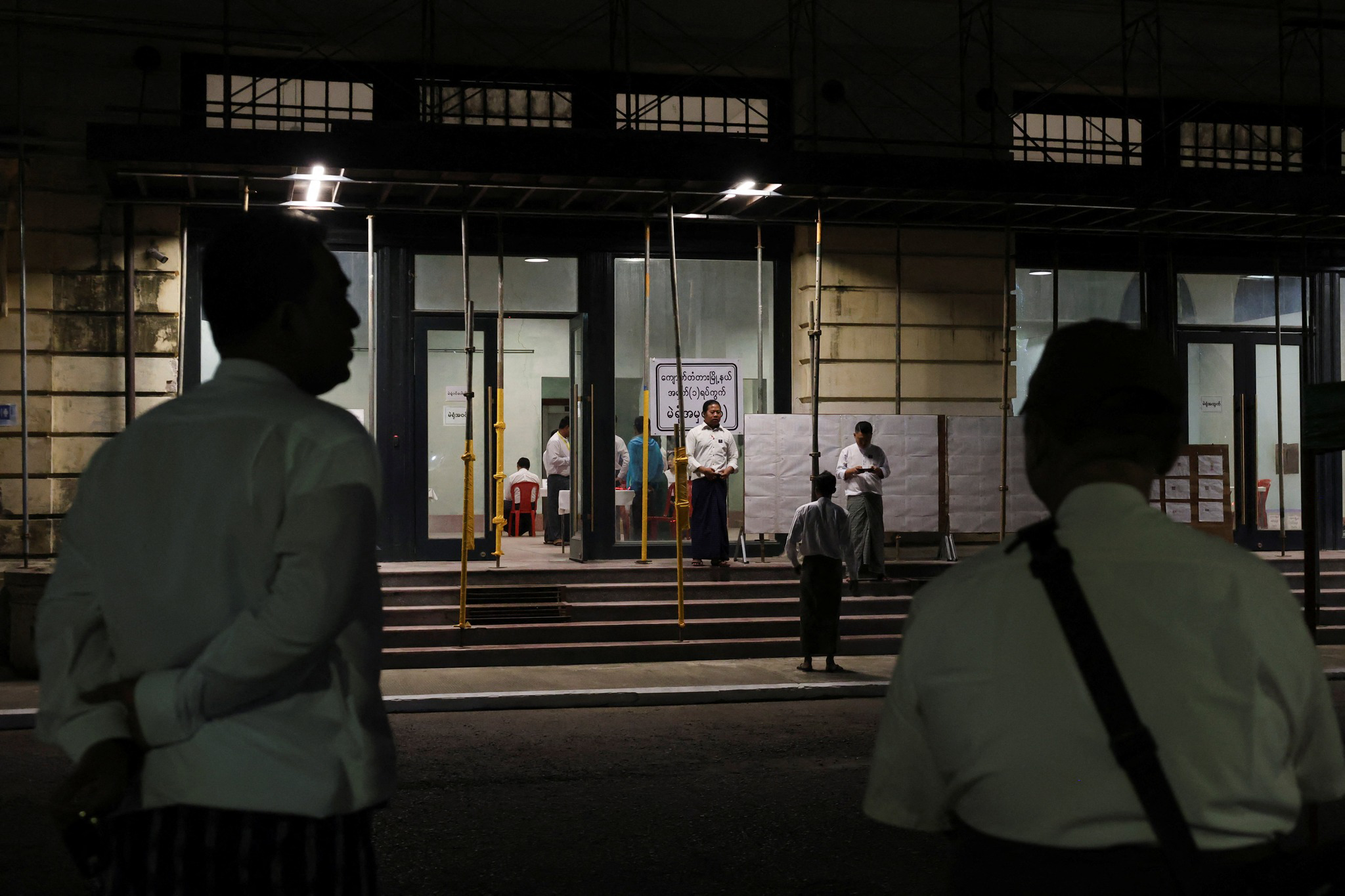
At the time of writing, it is the morning of December 28. This Spring Chronicle scene corresponds to developments up to December 27. In Yangon, eyewitnesses report that the city was unusually quiet on election morning. Some polling stations were under heavy security, while others appeared calm and uneventful, as if nothing extraordinary were taking place.
In the nationwide general election held on November 8, 2020, the National League for Democracy (NLD), led by Daw Aung San Suu Kyi, won a landslide victory. Claiming widespread electoral fraud, the Myanmar military—under the leadership of Min Aung Hlaing—seized state power nearly three months later, annulled the election results, and promised to hold a new election.
Five years later, that promise has materialized in the form of a military-imposed election, conducted amid a country engulfed in civil war. Across Myanmar, armed conflict is widespread; millions of civilians have been displaced; and tens of thousands of young people have become armed fighters in the Spring Revolution. It is under these conditions that the military—operating under the name of the State Administration Council (SAC)—has proceeded with its election, relying on political backing from neighboring countries such as China, India, and Russia.
At the time the first phase of the military’s election is being held, Daw Aung San Suu Kyi—who remains the most popular political figure in the country—is still imprisoned. No one can provide credible assurances regarding her health. The NLD, which won the 2020 election, has been dissolved by the military. Its leaders, along with other opposition figures and organizations, have spent the past five years confronting the military through the formation of bodies such as the NUCC, CRPH, and NUG, which now approach their sixth year of resistance as Myanmar moves into 2026.
Ahead of the forced election, the military announced an amnesty, claiming to release some political prisoners and to drop charges—including Section 505 cases—against individuals in hiding. State media reported that many people had returned to their hometowns as a result. However, there has been little independent confirmation or public testimony from those directly affected.
One significant blow to the military at the final stage of election preparations came from international digital platforms. A number of Western-based social media and multimedia platforms removed military propaganda channels. Justice For Myanmar reported that TikTok, a Chinese-controlled platform, took its first-ever enforcement action by removing MWD News (Myawaddy News), one of the military’s key propaganda outlets. Although some channels attempted to reappear, Facebook subsequently removed newly created MRTV pages and MRN pages that were reposting MRTV content. Earlier removals had already taken place on YouTube, Twitch, and Kick, affecting MITV and other state-linked outlets.
As a result, the military has lost its ability to directly broadcast election narratives to international audiences through global platforms. It must now rely on domestic and foreign media intermediaries to convey its messages. For the military, international recognition or non-recognition appears less important than the fact that it has managed to stage the election itself. What matters to the generals is recording this step as proof that they can manufacture a political “exit” or turning point from the election process.
Facing intense military pressure with no clear battlefield breakthrough, the Myanmar military appears to be using the forced election to fabricate a political front—an attempt to redirect attention and reshape pressure through a staged political maneuver.
Regarding ASEAN’s Five-Point Consensus on Myanmar, the core elements can be revisited as follows:
Immediate cessation of violence — This has not been achieved. Military operations and airstrikes have continued unabated, with no meaningful reduction at any point.
Inclusive dialogue among all stakeholders — This remains impossible, as the military has outright rejected such engagement.
Appointment of an ASEAN Special Envoy — Although ASEAN appoints envoys on a rotating basis, the military has denied them free access to Daw Aung San Suu Kyi and other political leaders, severely limiting effectiveness.
Humanitarian assistance via the AHA Centre — While aid has been attempted through ASEAN mechanisms, military control and interference have prevented effective delivery.
Special Envoy visits and meetings with all parties in Myanmar — As with Point 3, this has failed in practice.
ASEAN has so far refused to formally recognize Min Aung Hlaing, limiting engagement to “non-political representatives.” However, should the military attempt to present a new parliament and government formed through this forced election, ASEAN may face a turning point: whether to engage with figures emerging from a military-backed legislature.
While Min Aung Hlaing himself has failed to implement the Five-Point Consensus, questions now arise as to whether ASEAN—or China—might respond differently if a new, election-produced administration claims to act on his behalf. Will ASEAN revise its roadmap, or continue using it to engage with what would effectively be a military puppet parliament and government?
Meanwhile, revolutionary organizations have reiterated their commitment to their Six Common Political Objectives in the aftermath of the military’s forced election. These include:
Ending military dictatorship and removing the military from politics.
Completely abolishing the 2008 Constitution and resisting all attempts to revive it.
Establishing a federal democratic constitution acceptable to all stakeholders.
Placing all armed organizations under the control of a democratically elected civilian government.
Building a new federal democratic union in accordance with that constitution.
Ensuring justice for victims of abuses—including gender-based violence—and implementing transitional justice processes.
These principles reaffirm the joint political declaration issued on February 3, 2025, by the Chin Brotherhood (CB), CRPH, NLD, NUCC, and NUG.
In broad terms, there is still no visible convergence point between ASEAN’s roadmap, the military’s attempted exit via a forced election, and the firm stance of the Spring Revolution’s leadership.
For ordinary people inside Myanmar—already struggling to survive amid war, displacement, and economic collapse—the future looks even heavier. Beyond the violence of armed forces, they may now face renewed repression from political actors aligned with the military. It is this compounded burden that weighs most heavily on the country’s people.