
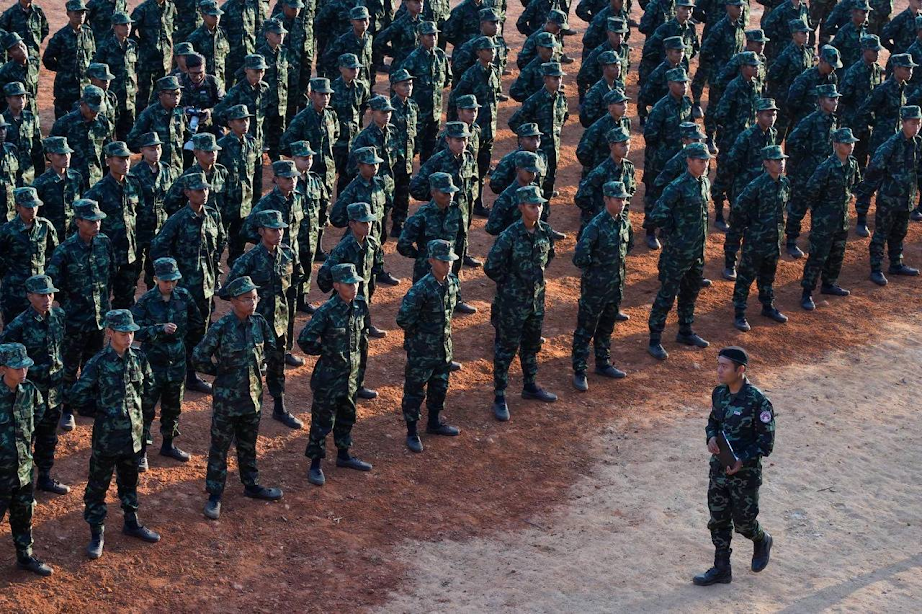
Myanmar Spring Chronicle – December 15 Scene
(MoeMaKa) 16 December 2025
A new Spring Revolution Alliance force has emerged
In yesterday’s MoeMaKa Chronicle, I wrote about how the coup regime’s army has a “blind spot” toward the movements and activities of the Spring Revolution forces — meaning, the revolutionaries can suddenly “explode into view” from a place the junta cannot see, strike hard, and withdraw.
One reader even half-seriously, half-mockingly asked whether this wasn’t actually more like “NUG Reform” — an unexpected move against the junta. I think everyone generally understands that I wasn’t trying to compare it directly with NUG Reform.
And then, that very same afternoon, news broke that a new Spring Revolution alliance force had been formed. According to the reports, a Spring Revolution Alliance (SRA) made up of 19 resistance forces has been created to launch strategic military offensives against the junta.
They have pledged to wage the struggle in line with the people’s demands and the goals of the revolution: bringing an end to military dictatorship and establishing a federal democratic system.
In their four-point pledge, they state that, because the people are facing severe hardship due to the junta’s crimes and human rights violations, the alliance will fight with its combined forces for the liberation of the public.
The Spring Revolution Alliance has also announced that it will further invite Spring Revolution forces that are not yet part of the coalition, in accordance with its policy principles and criteria.
In the past, many criticized the NUG’s attempts at forming structures, and there were efforts to set up joint commands and alliances by name.
This time, however, we can say that a joint force has emerged formed by revolutionary organizations that stand independently of the NUG label. That is how this alliance should be understood.
News outlets have been reporting this, and in the reader comment sections most people are welcoming it as a positive development.
The news of the formation of the Spring Revolution Alliance (SRA) has energized the public. People generally see it as something that boosts morale.
Judging from readers’ comments, some even say they are more interested and excited about this than when they first heard about “NUG Reform.”
This alliance consists of 19 groups: forces made up of majority Bamars, locally based formations, as well as ethnic armed groups.
That inevitably brings to mind what the NUG’s Acting President said in his speech announcing NUG Reform — that there were difficulties in forming alliances with ethnic armed organizations (EAOs).
He said, in essence:
“When we carefully examined why major ethnic armed organizations have not been able to fully and deeply participate in the NUG’s reform process, we found that over 60 years of civil war have been driven primarily by long-standing historical grievances and ethnic hatred.”
Seen in that light, we might say that the newly emerged SRA has, in some respects, managed to push beyond some of those constraints.
In the initial 23 November SRA statement and again in the 15 December statement, one word that stands out is “command.”
The first time, it appeared in their revolutionary pledge as:
“We will work to bring about a clear, effective and strong command structure.”
The second time, it came up in an interview with Min Han Htet from the Student Armed Forces (SAF), the SRA spokesperson who said, in essence, “In terms of command, we are not under the NUG.”
From this, it is understood that the SRA will move forward under its own code of conduct (CoC). At the same time, we hear that there have been discussions with the NUG and that they intend to maintain strong coordination and links.
The alliance brings together 19 well-known revolutionary forces such as KNDF, BPLA, Chin Brothers (CB), and the Student Armed Forces (SAF).
The initial coordination began with 7 groups in May, and by holding a three-day conference starting on 21 November they were able to bring together the current 19 groups.
A comrade involved with some of these organizations commented:
“We’ve been working for more than a year now to persuade and organize each group so that this could happen, so I welcome it. I hope the remaining groups will join in more. To uproot dictatorship, I firmly believe there is no path other than united struggle like this. We also need more involvement from the EROs (ethnic resistance organizations).”
Maung Saung Kha, the leader of BPLA — which often says that apart from fighting the military with military means it does not prioritize other matters — also played an active, hands-on role in making this kind of alliance possible.
In the 15 December announcement, the name of KNDF leader Khun Be Htuu is placed at the very front, which suggests this alliance is not just a “fireworks display” created to excite the public, but something more serious and substantive.
In a BBC interview, they also made it clear that they have a defined leadership structure for their next steps.
Min Han Htet said:
“As an alliance, we have a central leading committee. It’s a committee made up of representatives from each member organization within the alliance. This committee will be responsible for implementing operations, campaigns and military activities.”
He added that the alliance’s manpower is in the tens of thousands, and that they will be drawing up and implementing larger-scale, more strategic operations.
From such statements, we can understand that they are trying to say: this is not like the earlier 1027 operations, where they simply followed decisions led by three allied groups; they intend to have their own clearer leadership role.
In short, this is an alliance of revolutionary forces that are not under the NUG’s Ministry of Defense (MOD).
We can assume the MOD also tried to achieve something similar but was not successful.
From the public’s side, people are hoping that these forces can work together, provide mutual support where needed, and coordinate logistics.
Some comrades involved in support networks have commented that they see this as a good opportunity to concentrate their backing in a more unified way rather than spreading it thin.
Khun Be Htuu, a leader in both the Karenni State Interim Executive Council and KNDF, was previously rumored—though never confirmed—to possibly join the NUG cabinet through NUG Reform. That did not happen.
However, his name now appears openly in the SRA announcement, which many analysts say is a significant sign of SRA’s ability to unite key forces.
The Student Armed Forces (SAF) and Chin Brothers (CB) are known to be allied with the Arakan Army (AA). For that reason, some observers see “AA’s fingerprints” behind the formation of this Spring Revolution Alliance.
The fact that scattered forces are being brought together in this way is something that should happen and is to be welcomed.
It is also a challenge for the NUG. As SRA’s organizing efforts grow stronger, the alliance could expand beyond the original 19 groups.
We already understand this as a military alliance, but it will be interesting to see what kind of political cooperation emerges.
Because all of the organizations in SRA are revolutionary forces that were born out of the Spring Revolution itself, we can expect that their thinking, perspectives, and priorities will be relatively close.
The fact that previously scattered forces are now coming together is a positive sign.
What the public hopes for is that they can manage this in a way that avoids internal clashes and friction and that they can coordinate and adjust among themselves for the common cause.