
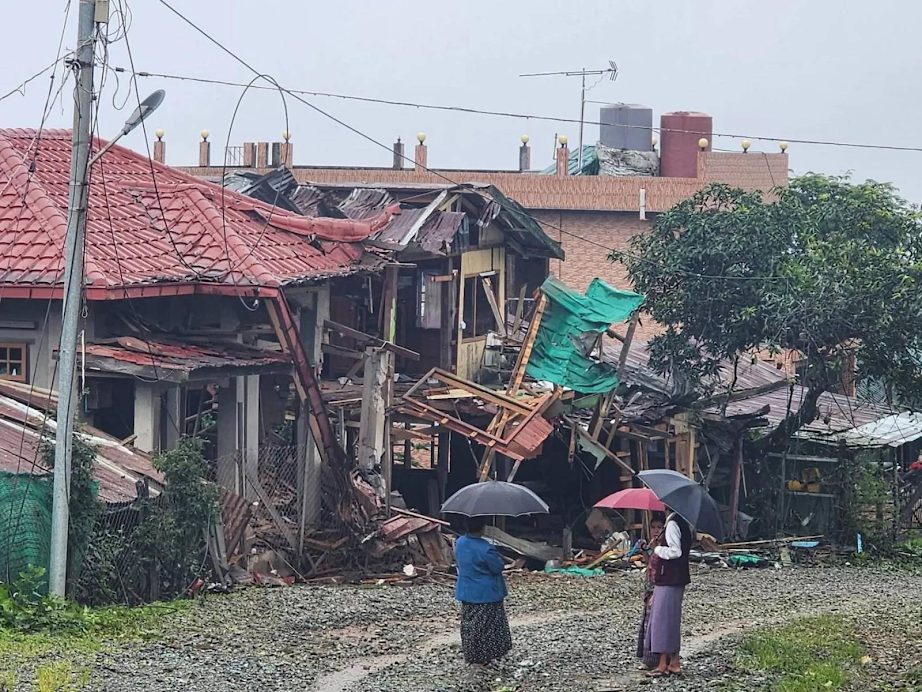
Myanmar Spring Chronicle – Scenes of December 9
(MoeMaKa) December 10, 2025
World Bank report and Myanmar’s economy during wartime
In the final few weeks of this year, the World Bank released its monitoring and assessment on Myanmar’s economy. According to that assessment, there are said to be “some signs” that Myanmar’s economy is stabilizing or recovering. The forecast now is that Myanmar’s Gross Domestic Product (GDP) will contract by 2 percent in the coming fiscal year. This is 0.5 percentage points better than the earlier forecast made shortly after the major Sagaing earthquake in mid-year.
The report explains that this upward revision of 0.5 percentage points is mainly due to reconstruction activities after the earthquake and targeted assistance to the communities that suffered the worst damage, which prompted the World Bank to adjust its earlier projections. It also notes that from April to September, the volume of goods transport and trade flows increased to some extent.
Although inflation continues, the report says that compared to previous years, inflation remained stable throughout 2025 and the kyat has appreciated somewhat again. Challenges highlighted include limited fiscal resources for post-earthquake reconstruction, insecurity due to ongoing conflict, and inadequate electricity supply.
On the junta’s side, there has been no explicit sign of endorsement or agreement with these World Bank figures, and some international economists have also commented that the report does not reflect the true situation on the ground.
The underlying argument is that the current economic assessment does not capture how severe conditions remain for people inside Myanmar. The World Bank likely relied on its own in-country staff and experts to compile this report. Taken at face value, the report implies that Myanmar’s economy has passed through its “worst phase.”
But this does not really factor in how fighting is ongoing and how logistics, trade, agriculture, livestock, and other production capacities have been heavily disrupted. Nor does it fully reflect how the enforcement of compulsory military service has driven large numbers of young people out of the country by various means, shrinking the domestic labor force.
As the report itself notes, Myanmar is still facing inflation of around 20 percent, even though it claims the kyat has stabilized during 2025. While that may be statistically correct, in practice this “stability” in the kyat was achieved by heavily restricting imports, especially consumer and household goods. This has pushed prices of everyday goods sharply upward and driven up the cost of daily food items that people rely on.
Restrictions were imposed on goods brought in via border trade from Thailand and China as well as on regular imports of pharmaceuticals and other products. As a result, cooking oil, detergent, toothpaste, medicines, and other basics have become very expensive and hard to afford. These import restrictions were imposed partly to suppress demand for foreign currency, in order to hold the exchange rate at around 4,000 kyat per US dollar.
So while the kyat may have been “stable” in 2025, transport costs, the cost of living, food prices, and general commodity prices have not decreased; they have continued to rise.
In reality, Myanmar’s economic condition is that of a war-time economy. Because armed conflict is occurring in more than half of the country’s territory, people in those areas cannot properly farm, raise livestock, produce goods, or trade as they would under normal conditions. There are countless fields where crops were planted but could not be harvested. In some places, even when harvesting is possible, there are no buyers, or farmers cannot get fair prices, or they are blocked from transporting rice and crops across borders.
Because the usual trade routes to China are not easily accessible, paddy cannot be exported, and farmers face low farm-gate prices. In places like Rakhine, locally grown paddy and rice also face obstacles and restrictions in being transported to central Myanmar. This means farmers there are encountering low prices and sluggish sales as well.
Similarly, in areas such as southern and northern Shan State, maize grown by farmers often cannot be exported smoothly at harvest time. In conflict-affected regions, trade and travel are hindered by numerous obstacles—arbitrary checkpoints, excessive and arbitrary taxation, and the risk of damage or loss during fighting—all of which heavily impact production and marketing.
Under such war-time conditions, with weak or abnormal governance, there has also been widespread over-extraction of natural resources. The revenues from this excessive extraction are likely now forming a significant portion of what is counted as Myanmar’s “real” output in GDP. During expanded phases of conflict, one can see rapid increases in land clearance and mining for gold, rare earths, gemstones, jade, and timber from buffer forests and previously protected forests.
These kinds of activities have spread widely in areas such as Hpakant, Mogok, eastern Kachin State, eastern Shan, Sagaing Region, and Mandalay Region.
Most of the taxes and fees generated from this kind of over-extraction flow not into the public purse, but into the pockets of those who control the concessions and wield power: individual officials and commanders, armed groups, and the machinery of war itself. For the general public, there is little benefit to be seen.
As for the informal economy, the sheer scale of money involved in drug trafficking and online scam operations is still not fully captured in formal economic reports. Much of that money flows to criminal syndicates and the military or armed groups that protect them. Some local people do earn income by providing services to these operations, but that is a narrow slice of the population.
In summary, even if the World Bank report suggests that there are “some signs” of recovery or stabilization in Myanmar’s war-time economy, for ordinary people the reality is quite different: they are struggling to survive under a crushing cost of living and a web of formal and informal taxes and fees that are tightening like a noose around their necks.